Anxiety and Cancer: Coping Tools for Stress and Uncertainty
Learn what anxiety is, why it happens, and simple ways to manage it during stressful seasons like cancer treatment. Explore grounding techniques, breathing exercises, and support resources.
Share This Post




What is anxiety? According to the Diagnostic and Statistical Manual of Mental Disorders, 5th Edition, “Anxiety is anticipation of future threat,” (American Psychiatric Association, 2022). However, it shows its self in its own unique, individualized way for each of us. It may be racing thoughts, heart palpitations, or sleepless nights.
Understanding Anxiety Through the “Fire Alarm” Metaphor
Before becoming a mom, I worked as a therapist with children, many of whom struggled with anxiety. I often explained anxiety like a fire alarm: it exists to protect us and alert us to danger. But sometimes, like a smoke alarm going off from slightly burned popcorn, it can become overly sensitive and sound the alarm even when we are safe. Anxiety can work the same way—our brain’s “fire alarm,” the amygdala, can become hyperactive, making everyday situations feel dangerous even when they are not. While anxiety can be much more complex, especially for those who have experienced trauma, this metaphor helps explain how anxiety can sometimes feel loud, constant, and overwhelming.
Turning Down the “Car Radio” of Anxiety
At the Keith the Cat Foundation, the mission is to support those affected by cancer, where fear and anxiety often come with very real concerns—waiting for test results, navigating treatment, financial stress, and uncertainty about the future.
Intrusive thoughts can become so loud that they make it difficult to stay present. I often compare these thoughts to a loud car radio: distracting, consuming, and hard to tune out. In therapy, we teach skills to acknowledge those “gloomy” thoughts without letting them take over—to let them become background noise so we can still focus on the present moment and find joy and light, even during difficult seasons.

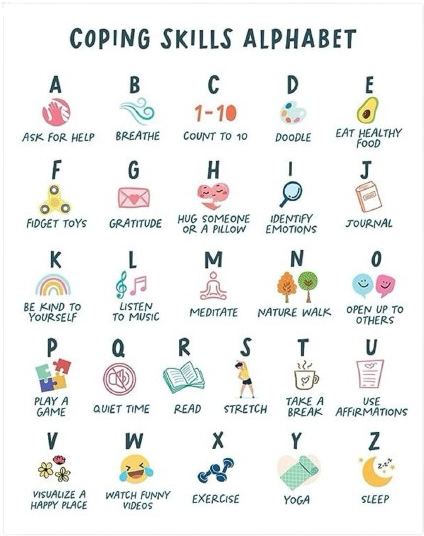
My goal of providing the “faulty fire alarm” and “car radio” metaphor is to convey that, while our anxiety may make us feel alone, inferior, or weak, it is normal and we can find ways to make it more manageable during times of stress. There are several ways to manage our anxiety. Here are just a few:
- Grounding Techniques: The 5-4-3-2-1 Method: Grounding strategies are similar to “turning down the radio” and focusing on our present moment. One that I like is 5-4-3-2-1, where you notice 5 things you see, 4 things you feel, 3 things you hear, 2 things you can smell, and 1 thing you can taste.
- Deep Breathing and Box Breathing: Breathing exercises can support our nervous system and help tame our fire alarm (Bentley et al., 2023). One of my favorites is box breathing, where you breath in 4 seconds, hold it for 4 seconds, breath out for 4 seconds and hold it again for 4 seconds, and repeat a few times.
- Sign-up for a support group: According to the National Cancer Institute (2024), many hospitals, cancer centers, community groups, and schools offer different types of support groups, to include in-person and online groups. Some research shows that joining a support group improve quality of life. Check out https://www.cancer.org/support-programs-and-services.html to find a support group near you.
We understand how challenging medical treatment can be, so we created “Keith the Cat” shirts and hats to help spread comfort and connection during times of anxiety and stress. We at the Keith the Cat Foundation are here for you.
Works Cited
American Psychiatric Association. (2022). Diagnostic and statistical manual of mental disorders (5th ed., text rev.). https://doi.org/10.1176/appi.books.9780890425787
Bentley, T. G. K., D’Andrea-Penna, G., Rakic, M., Arce, N., LaFaille, M., Berman, R., Cooley, K., & Sprimont, P. (2023). Breathing Practices for Stress and Anxiety Reduction: Conceptual Framework of Implementation Guidelines Based on a Systematic Review of the Published Literature. Brain sciences, 13(12), 1612. https://doi.org/10.3390/brainsci13121612
National Cancer Institute. (2024). Cancer Support Groups. https://www.cancer.gov/about-cancer/coping/adjusting-to-cancer/support-groups

Savannah Doyle- Executive Team at Keith the Cat Foundation
Savannah Doyle is a Licensed Clinical Social Worker from Virginia Beach, Virginia. She received her Master of Social Work from Boise State University. She is a former intensive in-home and outpatient clinician serving families and children providing evidence-based, trauma-informed, and individualized care. Savannah is now a new mom to a beautiful baby girl.

We are a non-profit organization working towards helping those with cancer find comfort, support, and resources.


Comments
If you’d like to reach out or leave us a comment, we’d ❤️ to hear from you — send us an email here or just follow this link to our Facebook page.